
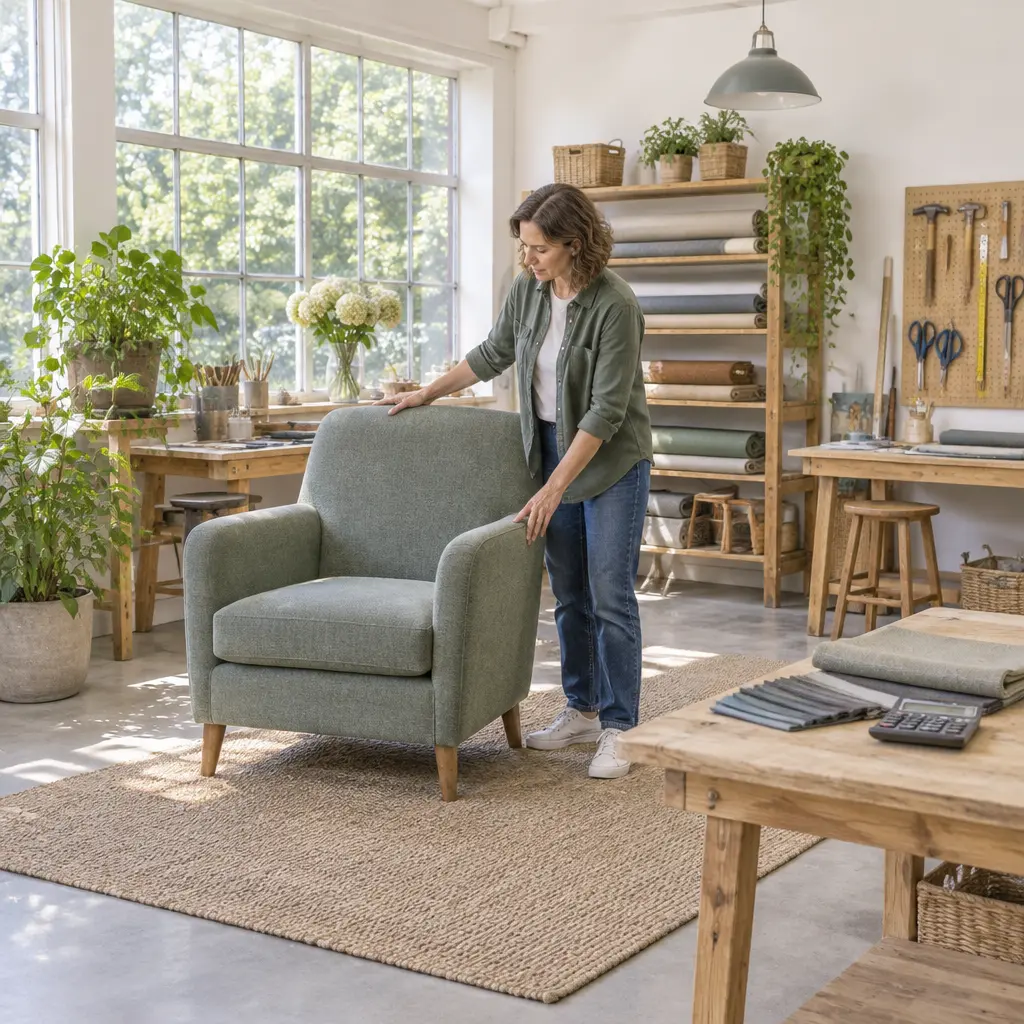
Custom upholstery’s cost-per-year measures what a made-to-fit upholstered piece costs for each year it remains useful, making it easier to compare a restoration or custom build with replacing trendy, lower-cost furniture every few years. The calculation is simple—total ownership cost divided by years of service—but the result depends on realistic lifespan, repair, and maintenance assumptions. That matters in a market where the U.S. Environmental Protection Agency estimates that 12.1 million tons of furniture and furnishings became municipal solid waste in 2018, with 80.1% landfilled. Comparing annualized cost, durability, comfort, and waste can therefore reveal when custom upholstery is a practical long-term investment rather than merely a premium purchase.
Custom Upholstery Defines Cost-Per-Year Value
Cost-per-year is an ownership metric: divide the purchase and upkeep costs of an item by the number of years it provides useful service. The Consumer Financial Protection Bureau uses the broader idea of total cost to encourage consumers to look beyond an item’s initial price; for upholstered furniture, the same principle means including fabric, labor, delivery, cleaning, and repairs rather than comparing sticker prices alone.
A basic formula is: cost per year = (purchase price + cumulative maintenance and repair costs − resale or salvage value) ÷ years of useful service. For a reupholstered chair, include the chair’s acquisition cost if it was not already owned. For a piece being restored, distinguish the upholstery investment from the original furniture price so that comparisons remain fair.
Custom Upholstery and Its Main Categories
Custom upholstery is the selection and fitting of upholstery materials and construction for a specific furniture frame, rather than buying a finished piece in a standard fabric and configuration. Its common categories include reupholstery, which replaces or renews the covering on an existing frame; made-to-order furniture, built to specified dimensions and finishes; and commercial upholstery, designed for settings such as hospitality, offices, and public spaces.
The value of each category depends on more than fabric appearance. Frame condition, cushion construction, seam quality, fabric abrasion performance, cleaning needs, and expected daily use all influence how long the furniture remains serviceable. The Association for Contract Textiles, for example, publishes performance guidance for fabrics used in commercial interiors, where repeated use makes durability requirements especially important.
Cost-Per-Year Compared With Purchase Price
Purchase price is the amount paid upfront; cost-per-year spreads the net ownership cost over the item’s usable life. Consider an illustrative comparison: a $1,200 custom-upholstered sofa lasting 15 years costs $80 per year before maintenance. A $500 trend-led sofa lasting five years costs $100 per year before replacement delivery or disposal. These are examples, not universal lifespan benchmarks; actual service life varies with frame quality, use, care, and repairability.
A simple chart could show the two examples as annual bars: $80 for the custom sofa and $100 for the trend-led sofa. The comparison becomes more informative when it also shows sensitivity to lifespan—for instance, the custom sofa’s annual cost rises to $120 if it lasts only 10 years, while the lower-cost sofa’s falls to about $71 if it lasts seven years.
Useful Life Determines Custom Upholstery Cost-Per-Year
Useful life is the period during which furniture remains safe, functional, comfortable, and acceptable to its owner. It is not necessarily the same as the product’s physical survival: a sofa may remain structurally sound after its style, fabric, or comfort no longer suits the household. The U.S. Environmental Protection Agency’s furniture-waste figures underline why extending useful life can matter environmentally as well as financially.
Frame and Construction Longevity
Frame longevity refers to how well the furniture’s structural base withstands load and repeated use. A sound hardwood frame with secure joints may be a strong candidate for reupholstery, while a damaged frame, loose joints, or compromised support system can make new fabric a poor investment unless structural repairs are included.
Before commissioning work, ask the upholsterer to inspect the frame, springs or webbing, cushion cores, and joints. Request separate estimates for structural repairs and covering work. This prevents a visually refreshed piece from being mistaken for a fully restored one and makes the cost-per-year estimate more credible.
Fabric Durability and Maintenance
Fabric durability is a material’s ability to resist wear and retain useful appearance under expected conditions. Performance depends on fiber, weave, finish, color, exposure to sunlight, pets, spills, and cleaning method. Abrasion-test results can help compare fabrics, but they do not guarantee a specific number of years in a home; real-world wear also depends on how the furniture is used.
The Association for Contract Textiles’ ACT performance guidelines provide specifications for commercial upholstery fabrics, including abrasion, colorfastness, and other properties. Residential buyers can use the same general principle—match performance to use—while checking a fabric maker’s care instructions and test information. A high-performance fabric may cost more initially but can reduce cleaning difficulty or premature replacement in a busy household.
Repairability and Changing Style
Repairability is the ability to restore function or appearance without discarding the entire item. Replaceable cushion covers, accessible components, a sound frame, and locally available repair expertise can extend service life. Reupholstery also offers a way to update color or pattern while retaining a frame that still meets the owner’s needs.
Style is a separate lifespan factor. A trend-led design may feel dated before its structure wears out, while a classic shape and changeable covering can remain appealing longer. Choosing a neutral or enduring base and using smaller accessories for seasonal trends can help avoid paying for repeated full-furniture replacements.
Replacement Cycles Change the Investment Comparison
A replacement cycle is the interval between purchases of successive furniture items. The relevant comparison is not simply one custom sofa against one inexpensive sofa; it is the custom piece against all replacements needed to provide the same service over the same period. Include repeat purchase prices, delivery, disposal, maintenance, and any difference in comfort or suitability.
A Break-Even Calculation
Break-even analysis identifies how long a custom piece must last for its annualized cost to match an alternative. Suppose custom upholstery costs $1,200, while a comparable trend-led sofa costs $500 and lasts five years. Over a 15-year comparison, three trend-led sofas cost $1,500 before delivery and disposal. If the custom piece lasts 15 years and needs $300 in maintenance, its total is $1,500—equal to the purchase-only cost of the three replacements. If it needs less maintenance, lasts longer, or avoids replacement fees, it may compare favorably; if it requires expensive repairs or falls out of use early, it may not.
This calculation should use the same time horizon for both options and state assumptions plainly. It is also useful to test several service-life scenarios rather than rely on a single optimistic estimate. A small table or line chart can show annual cost as lifespan changes, making the break-even point visible to the buyer.
Ownership Costs Beyond the Invoice
Total ownership cost includes expenses that occur after purchase. For upholstery, relevant items may include professional cleaning, cushion replacement, frame repairs, delivery, storage during work, and disposal or resale. If the furniture is used in a high-traffic home or business, more frequent cleaning and repairs may materially change the comparison.
The U.S. Bureau of Labor Statistics’ Consumer Expenditure Surveys track household spending categories, including furniture and related goods, and provide context for how furniture purchases fit within broader household budgets. Individual buyers should still use their own quotes and expected maintenance costs: national spending averages cannot predict the cost or lifespan of a particular sofa.
A Practical Method for Evaluating Custom Upholstery
A reliable estimate combines comparable quotes, a condition assessment, and conservative lifespan assumptions. The following steps help keep the decision grounded in evidence rather than trend appeal or a low initial price.
- Inspect the frame, joints, springs or webbing, and cushions; identify repairs needed before covering work begins.
- Get an itemized upholstery quote that separates labor, fabric, cushion work, structural repairs, delivery, and taxes.
- Compare fabric performance and care instructions with the furniture’s real use, including pets, children, sunlight, and spills.
- Estimate years of useful service for both custom and replacement options, and test more than one lifespan scenario.
- Add likely maintenance, repair, delivery, and disposal costs; subtract realistic resale or salvage value if applicable.
- Divide net total ownership cost by years of useful service, then compare comfort, fit, repairability, and environmental implications alongside the annual figure.
For example, a household with a well-built inherited chair may find reupholstery compelling because the frame is already owned and can be retained. A renter who expects to move soon, or someone whose needs are likely to change, may reasonably prioritize lower upfront cost and flexibility instead. Cost-per-year is a decision aid, not a guarantee that the higher-priced option is always better.
Conclusion: Use Cost-Per-Year to Compare Furniture Fairly
Custom upholstery cost-per-year links initial price to useful life, maintenance, repairability, and replacement cycles. The most meaningful comparison accounts for frame condition, fabric performance, total ownership costs, and the number of lower-cost replacements needed over the same period. EPA furniture-waste data also shows that extending furniture life has implications beyond household budgets, although environmental benefits depend on the materials, transport, repair work, and disposal avoided.
Before deciding, obtain an itemized quote, ask for a frame and cushion assessment, and calculate several realistic lifespan scenarios. Use the annual cost as one measure alongside comfort, fit, appearance, and waste reduction. For further research, consult the EPA’s materials on municipal solid waste, the Association for Contract Textiles’ performance guidelines, and the Bureau of Labor Statistics’ Consumer Expenditure Surveys.
Sources: U.S. Environmental Protection Agency, Advancing Sustainable Materials Management: 2018 Fact Sheet, https://www.epa.gov/sites/default/files/2020-11/documents/2018_ff_fact_sheet.pdf; Association for Contract Textiles, ACT Performance Guidelines, https://contracttextiles.org/performance-guidelines/; U.S. Bureau of Labor Statistics, Consumer Expenditure Surveys, https://www.bls.gov/cex/; Consumer Financial Protection Bureau, Your Money, Your Goals: A Financial Empowerment Toolkit, https://www.consumerfinance.gov/consumer-tools/educator-tools/your-money-your-goals/