
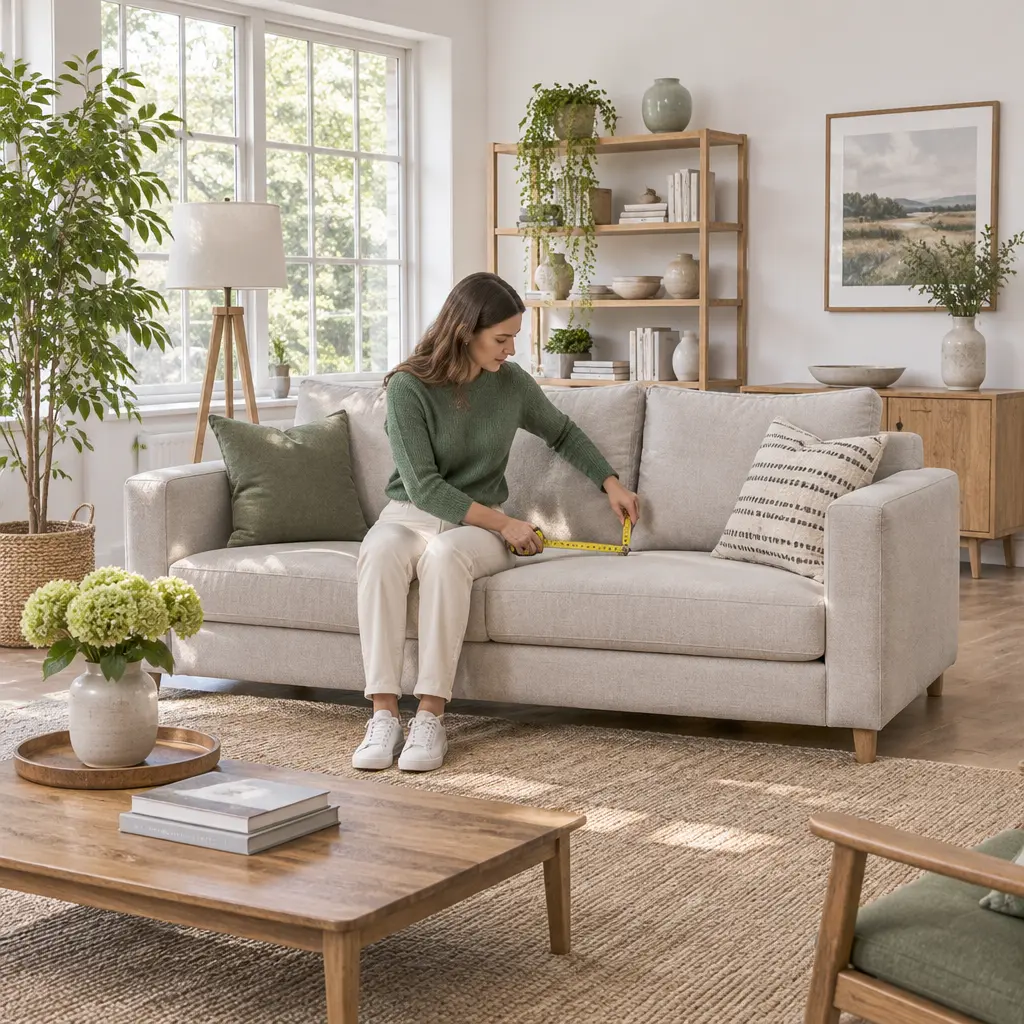
A sofa’s seat depth is the horizontal distance from the front edge of the seat to the back cushion, and choosing it well means matching that measurement to the people who will use the sofa most. Seat-depth testing at home can reveal whether shorter- and longer-legged household members can sit with their feet supported and backs comfortably supported. There is no single depth that fits everyone: furniture-industry guidance commonly places standard sofa seat depth around 21–24 inches, while deeper lounge styles often exceed that range. Because discomfort can arise from a mismatch between body proportions and furniture dimensions, testing actual seats—not relying on a label or showroom impression—is a practical way to compare models, identify compromises, and select a sofa for everyday use.
Sofa Seat Depth and Household Fit
Seat depth is a furniture-fit attribute: it describes how far the usable sitting surface extends from the front seat edge toward the back support. The American Academy of Orthopaedic Surgeons advises that a chair should allow the user’s feet to rest flat on the floor while the back is supported; this ergonomic principle is useful when evaluating sofas, although a sofa’s soft cushions make its effective depth less straightforward than a rigid chair’s dimensions.
A sofa’s published measurement may refer to the frame or seat platform rather than the distance available after back cushions are installed. Cushion compression, lumbar pillows, and the user’s posture can all change the effective depth. A useful comparison therefore records both the manufacturer’s stated dimension and the household member’s experience when seated. The practical objective is not to find a universally correct number, but to identify a depth that works for the people who use the sofa and the ways they use it.
Seat depth, seat height, and usable depth
Seat depth is different from seat height, which is the vertical distance from the floor to the top of the seat cushion. Both affect fit: a deep seat may still feel uncomfortable if it is too high for someone’s legs, while a shallow seat may provide poor thigh support for a taller sitter. For a meaningful home test, measure from the cushion’s front edge to the point where the back cushion meets the seat, then sit normally and note how much room remains behind the knees.
Why body proportions matter
Overall height is only a rough guide to sofa fit. People of similar height can have different lower-leg and thigh lengths, so a test based on stature alone may miss the source of discomfort. Check whether the sitter can keep their feet supported while their back reaches the cushion. If the seat edge presses into the back of the knees, the usable depth may be excessive; if a large gap remains between the seat edge and the knees, the seat may be too shallow for relaxed support.
Testing Sofa Seat Depth Across Household Body Types
A household test compares the same sofa under consistent conditions: each person sits with their back against the cushion, feet placed naturally, and posture relaxed rather than forced. The resulting observations help distinguish a genuine fit issue from preferences about firmness or lounging. The Center for Inclusive Design and Environmental Access at the University at Buffalo emphasizes that user diversity is central to inclusive design; applied at home, that means checking the sofa against the actual range of household users rather than an imagined average body.
Shorter-legged sitters
For a shorter-legged sitter, a deep seat can make it difficult to sit back while keeping the feet supported. The person may perch at the front edge or place a cushion behind the lower back, reducing effective depth. Test the sofa with and without a lumbar pillow and note whether the feet remain stable and the back stays supported. A footstool can help with lounging, but it does not necessarily solve the fit problem for upright everyday sitting.
Longer-legged and taller sitters
A longer-legged sitter may prefer more seat depth because a shallow seat supports less of the thighs. During the test, check for comfortable thigh support without pressure at the knee crease. If the sitter has to slide forward to avoid pressure, the sofa may be too deep, even if its generous surface initially feels relaxing. Taller users should also test the back cushion and arm position: seat depth alone cannot establish whether the whole sofa supports a comfortable posture.
Children, older adults, and mobility needs
Children and some older adults may find a deep, low sofa difficult to use because sitting down and standing up can require more effort, while short legs may leave the feet unsupported. The National Institute on Aging recommends considering safety and ease of movement in the home environment, including stable seating that is easier to get into and out of. When a household includes people with mobility limitations, test the sofa’s depth together with seat height, cushion firmness, arm support, and the person’s ability to transfer safely. Individual clinical or occupational-therapy advice may be appropriate where seating is part of a medical or rehabilitation need.
Seat-Depth Categories and Their Trade-Offs
Sofas are often described as standard-depth, deep-seat, or compact-seat styles, but these labels are not a universal measurement standard. Retailer specifications and measuring methods vary, so compare actual usable dimensions rather than relying on category names. Common product guidance places many standard seats around 21–24 inches deep, while deep-seat designs are often roughly 25 inches or more; these are market conventions, not ergonomic thresholds that guarantee a fit.
Standard-depth sofas
A standard-depth sofa is intended to balance upright sitting and casual relaxation. It may suit mixed household use when several people sit on the sofa for conversation, reading, and television. But the range of bodies within a household can still make one standard model feel shallow to a taller person and too deep to a shorter-legged person. Verify the seat after cushions are fitted and compressed rather than treating a nominal measurement as the whole story.
Deep-seat sofas
A deep-seat sofa provides more room for reclining, curling up, or sitting cross-legged. It can be a good match for people who prefer lounging, but may encourage shorter sitters to slump or perch unless they use a supportive cushion. If household members have different preferences, test the sofa in both upright and relaxed positions. A model that feels comfortable only when someone reclines may not work well as the household’s main conversation or work-from-home seat.
Compact or shallow-seat sofas
A compact or shallow-seat sofa can make upright sitting easier for some shorter-legged users and may suit a smaller room. Its trade-off is reduced thigh support or less room to lounge for longer-legged users. The choice should account for the sofa’s main purpose: occasional guest seating may prioritize a compact footprint, while a primary family sofa may need more flexible support across different users and activities.
A Repeatable At-Home Sofa Fit Test
A simple test makes showroom impressions more comparable and helps households discuss fit using observable details. Measure the seat, record who tested it, and repeat the same sitting position on every candidate. If possible, test the sofa for several minutes and try the cushions in the configuration the household expects to use daily.
- Measure the usable depth from the front edge of the seat cushion to the back cushion, not just the frame.
- Have each household member sit with their back supported and feet placed naturally.
- Check for pressure behind the knees, unsupported feet, a gap behind the lower back, and whether the sitter can rise comfortably.
- Repeat with any lumbar pillow or footstool the household plans to use, noting that accessories change the effective fit.
- Record comfort for upright sitting and lounging separately, then compare the results across sofa models.
A simple comparison chart can include sofa model, measured usable depth, seat height, sitter, foot support, knee pressure, back support, and preferred activity. This makes trade-offs visible without pretending that a single measurement predicts comfort for everyone. It also helps identify a practical solution—such as a sofa that suits most users with a removable cushion for shorter sitters—rather than forcing every household member into the same posture.
Conclusion: Choose Seat Depth by Testing Real Users
Sofa seat depth is the usable front-to-back sitting space, but its comfort depends on body proportions, cushion construction, seat height, and intended use. Standard, deep, and compact styles offer different trade-offs; none is automatically right for every household. Measure the usable seat, test it with each regular user, and record foot support, knee comfort, back support, and ease of movement. Before buying, compare the manufacturer’s dimensions with an in-person or return-period trial, and seek tailored professional advice when mobility or health needs affect seating. A small amount of structured testing can make a large furniture purchase more inclusive and more comfortable for everyday life.
Sources: American Academy of Orthopaedic Surgeons, “Ergonomics: How to Set Up Your Desk,” https://orthoinfo.aaos.org/en/staying-healthy/ergonomics-how-to-set-up-your-desk/; University at Buffalo, Center for Inclusive Design and Environmental Access, “About IDeA,” https://idea.ap.buffalo.edu/about/; National Institute on Aging, “Aging in Place: Growing Older at Home,” https://www.nia.nih.gov/health/aging-place/aging-place-growing-older-home; The Spruce, “Sofa Dimensions: How to Choose the Right Sofa,” https://www.thespruce.com/sofa-dimensions-1391218.