
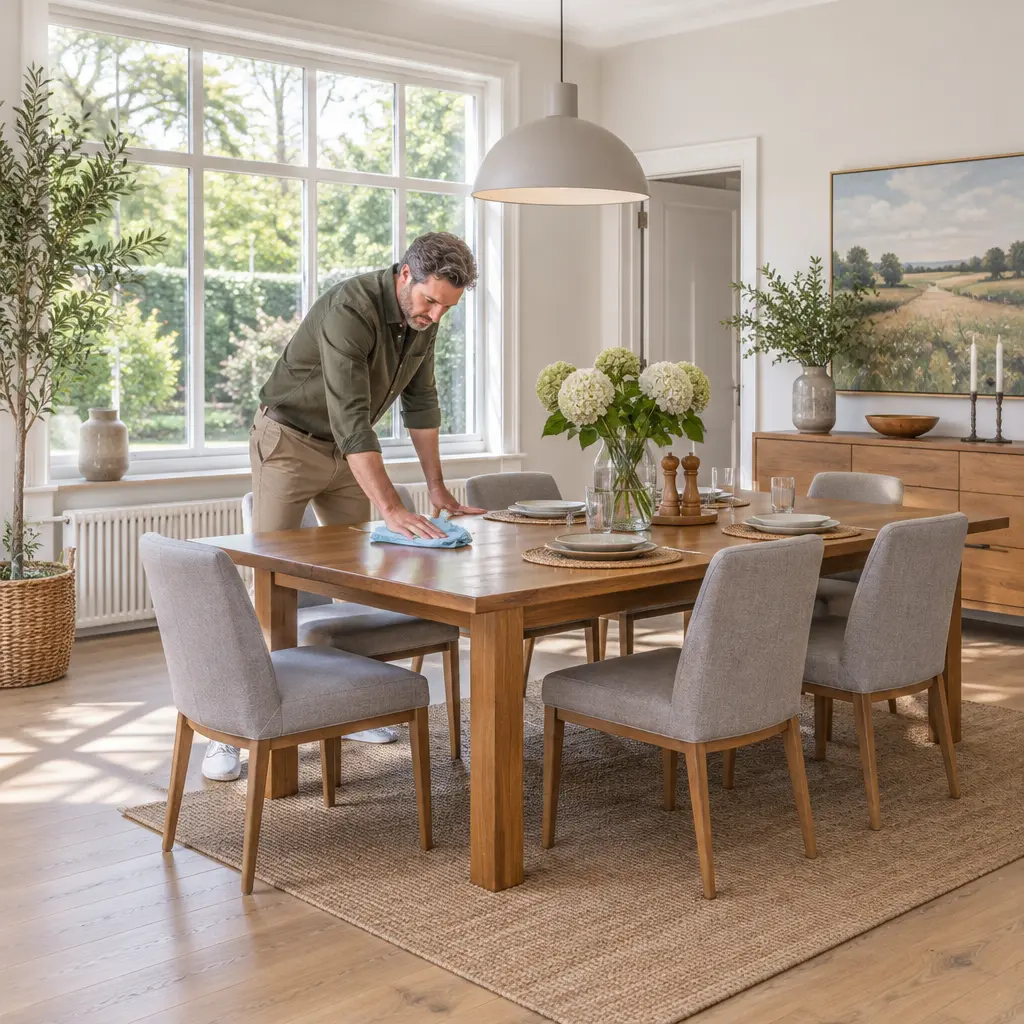
Dining tables face a difficult design brief: they must withstand meals, spills, heat, scratches, and everyday cleaning while still looking composed enough for formal occasions. Material choice is the balance point. Solid wood offers warmth and can often be repaired; stone and glass create a more formal appearance but bring different risks; and durable laminates can shrug off routine wear while imitating more delicate finishes. The best choice depends not on a single “strongest” material, but on the household’s habits, the table’s construction and finish, and the level of care its owners will provide. The U.S. Environmental Protection Agency notes that indoor air can contain pollutants from building materials and furnishings, making finish selection and ventilation relevant alongside appearance and durability.
Dining Table Materials and Everyday Durability
A dining table material is the surface and structural substance used to make the tabletop and, in many cases, its supporting frame. In practical terms, durability means how well a table resists the particular stresses it will encounter—such as abrasion, impact, moisture, heat, staining, and repeated cleaning—rather than whether it is simply “hard.” The USDA Forest Products Laboratory’s Wood Handbook explains that wood properties vary by species, grain direction, moisture content, and construction. That variability is why a thick hardwood top with a protective finish may perform differently from a thin veneer over a panel, even when both are described as wood tables.
For households with children, frequent guests, or daily meals, the useful comparison is between common material families: solid and engineered wood, stone and engineered stone, glass, and high-pressure laminate. Each has a different failure mode. Wood may dent or show water marks but can often be renewed; stone resists many scratches but can chip or stain depending on its composition and seal; glass is easy to wipe but can show fingerprints and edge damage; laminate is convenient and consistent but usually cannot be refinished if its surface is deeply damaged. Formal appearance is also shaped by edge details, color, sheen, base design, and maintenance—not just the material itself.
What “daily-abuse tolerance” means
Daily-abuse tolerance describes a table’s ability to remain usable and visually acceptable after ordinary household wear. It is not one standardized rating for dining furniture. A practical assessment separates resistance to scratching, denting, heat, moisture, stains, and impact, then considers whether damage can be repaired. The American Society for Testing and Materials publishes test methods for furniture and surface properties, but product results depend on the specific test, specimen, and construction; a single laboratory rating should not be treated as a complete forecast of years of home use.
This distinction matters because a material can be hard yet brittle, or soft yet repairable. A glass top may resist routine scraping but can be vulnerable at exposed edges. A wood top may acquire marks more readily but allow sanding and refinishing. For daily meals, use coasters, placemats, and trivets as low-cost protection, especially because manufacturers’ care instructions and finish warranties often exclude damage from standing water, excessive heat, or abrasive cleaners.
Formal appearance and material perception
Formal aesthetics refer to the visual qualities that make a table feel intentional and appropriate for a dining room, including proportion, material texture, finish, color, and detailing. Stone, polished wood, and clear glass are often associated with formal interiors, but no material is automatically formal: a well-proportioned laminate table can look refined, while an overly glossy or poorly detailed stone table may feel out of place. The American Society of Interior Designers emphasizes that material selection should respond to both function and the overall design scheme, a useful principle when balancing practical performance with visual coherence.
Wood Dining Tables: Repairability, Finish, and Formal Character
Wood tables include solid hardwood, solid softwood, veneer over engineered panels, and mixed constructions. The Forest Products Laboratory defines wood as a variable natural material whose strength, dimensional movement, and appearance depend on species and moisture conditions. For dining tables, this means the finish and construction are as important as the species name: a protective coating can improve resistance to spills, while a thin veneer may limit how much sanding is possible after damage.
Wood remains a strong choice for households seeking a formal look with the possibility of repair. It can be styled as traditional, contemporary, rustic, or minimalist, and small dents may be less conspicuous on a textured or matte surface than on a high-gloss finish. The trade-off is that wood moves with changes in humidity and can be marked by hot cookware, standing liquid, or sharp objects. A table’s maker should provide care instructions suited to the specific finish rather than generic advice for all wood.
Solid hardwood
Solid hardwood is lumber cut from broad-leaved tree species such as oak, maple, or walnut. It is valued for a substantial appearance, distinctive grain, and the potential to sand and refinish many times, subject to top thickness and joinery. The Forest Products Laboratory’s wood-property data show that hardness varies substantially among species, so “hardwood” is not a guarantee of equal scratch or dent resistance. A dense species such as maple may resist indentation better than a softer wood, but all wood can be damaged by sharp impacts and prolonged moisture.
For a formal dining room, solid hardwood pairs well with tailored silhouettes and can develop a patina over time. For daily use, a durable, repairable finish and prompt cleanup are more meaningful than choosing a species solely by reputation. Ask whether the top is solid throughout, how thick it is, and whether the finish can be renewed locally.
Wood veneer and engineered panels
A veneer table uses a thin layer of decorative wood over a stable core, commonly plywood or a composite panel. This construction can provide the look of fine wood while using material efficiently and limiting some forms of movement. Its main limitation is repair depth: deep scratches or chips may expose the core, and aggressive sanding can remove the veneer. The Composite Panel Association describes engineered panels as products made from wood strands, particles, or fibers bonded together, but performance depends on panel grade, edge protection, and the table’s assembly.
Veneer can be a sound choice when the table is well made and the household wants a polished appearance at a more accessible price. Check the tabletop edges and underside for signs of moisture protection, and avoid leaving wet cloths or spills in seams. A veneer top is less suitable when owners expect to sand away years of heavy wear.
Wood finishes: the practical surface layer
A finish is a coating or treatment applied to wood to influence appearance and protect it from moisture, stains, and abrasion. Film-forming finishes such as varnish or lacquer create a surface layer, while oils generally penetrate or leave a less substantial protective film, depending on the product. The National Wood Flooring Association’s guidance on wood finishes illustrates a broader principle relevant to furniture: finish type affects maintenance and repair, so care directions should match the coating rather than the underlying wood alone.
For frequent meals, a professionally applied, durable clear finish is usually easier to clean than an untreated or lightly oiled surface. Matte finishes can soften glare and conceal minor marks, while gloss can heighten formality but make scratches and fingerprints more visible. Before purchase, request the finish manufacturer’s cleaning instructions and confirm whether heat, alcohol, or household cleaners can damage it.
Stone Dining Tables: Formal Impact and Care Requirements
Stone tabletops include natural stones such as marble and granite, as well as engineered surfaces made from mineral particles and binders. The Natural Stone Institute explains that natural stone properties differ by geology and composition; porosity, hardness, and sensitivity to acids are not identical across stone types. Stone can deliver a strong formal focal point and resist many everyday scratches, but it is heavy, may chip at corners, and can require careful handling and cleaning.
The key buying question is not simply whether a stone is “sealed,” but what substances it resists and how the supplier recommends maintaining it. Sealer can reduce absorption in some stones, but it does not make every surface stain-proof or acid-proof. Marble, for example, can be etched by acidic foods and cleaners; a mark may be a change in surface finish rather than a removable stain.
Marble and other calcium-based stones
Marble is a natural stone composed primarily of recrystallized carbonate minerals and is prized for veining and visual depth. The Natural Stone Institute notes that calcium-based stones are sensitive to acids, including common kitchen substances such as lemon juice and vinegar. This makes marble a high-impact formal choice but a less forgiving surface for households that expect the table to remain pristine without immediate cleanup.
A honed finish can make small scratches and etching less conspicuous than a highly polished surface, though it does not eliminate chemical sensitivity. Use cutting boards and coasters, wipe spills promptly, and follow the stone fabricator’s cleaning and sealing guidance. Marble suits owners who welcome natural variation and patina rather than treating every mark as damage.
Granite and other harder natural stones
Granite is an igneous natural stone commonly selected for its dense appearance and resistance to routine abrasion. The Natural Stone Institute cautions that natural stone behavior varies by mineral composition and finish, so a label alone cannot replace product-specific advice. Granite can still chip, stain under some conditions, or suffer damage from harsh cleaners; its weight also requires a suitably strong base and careful delivery.
For a formal room that also sees frequent use, granite may offer a more forgiving option than acid-sensitive marble, especially when the selected slab and finish are confirmed with the fabricator. Inspect the actual slab when possible: natural variation means the delivered table may differ from a small sample.
Engineered stone
Engineered stone is a manufactured surface combining mineral content with binders and pigments. It can provide more consistent color and pattern than natural stone, but its heat, impact, and repair characteristics depend on the product formulation. The National Institute for Occupational Safety and Health has documented serious occupational exposure risks from respirable crystalline silica during fabrication of some engineered stone products. That concern primarily involves cutting and fabrication workplaces, not ordinary use of an intact, professionally installed tabletop; consumers should nevertheless use qualified fabricators and avoid unauthorized cutting or grinding.
Engineered stone may suit owners who want a consistent formal surface and straightforward routine cleaning. Before buying, consult the manufacturer’s current technical and care documents for heat limits, stain response, and repair options instead of assuming all engineered surfaces perform alike.
Glass Dining Tables: Visual Lightness and Edge Vulnerability
A glass dining table uses a glass top, usually supported by a separate wood, metal, or composite base. The National Glass Association explains that tempered glass is heat-treated to increase strength compared with ordinary annealed glass and that, when it breaks, it typically fragments into smaller pieces. Tempering does not make glass unbreakable, and impact at an edge can remain a concern. Buyers should verify whether the top is tempered and confirm that the table is designed for the specified glass thickness and load.
Glass creates a lighter visual footprint and can make a compact dining area feel more open, while its smooth surface is quick to wipe. However, fingerprints, dust, and scratches can be conspicuous, and a chipped edge may require replacement rather than simple refinishing. Rounded or beveled edges, protective pads, and careful placement away from high-traffic collision points can reduce practical risks.
Tempered glass and safe construction
Tempered glass is safety glass processed by controlled heating and cooling to create compressive stress at its surface. The U.S. Consumer Product Safety Commission identifies safety glazing requirements in certain building applications, but those rules should not be mistaken for a blanket certification of every furniture tabletop. For a dining table, request the manufacturer’s specification, including whether the top is tempered, its thickness, and the maximum supported load.
A well-designed glass table can be suitable for adults and older children when used as directed, but it is a less forgiving option in homes where toys, hard impacts, or rough handling are frequent. Check the table periodically for chips or cracks, and discontinue use if the glass is damaged.
Glass maintenance and visual trade-offs
Glass maintenance is simple in principle—use a suitable cleaner and a soft cloth—but high-visibility surfaces often need more frequent wiping to look formal. Abrasive pads can scratch some glass surfaces, and household cleaners may affect nearby metal or wood components. Clear glass visually exposes the base and floor beneath it, so the table’s supporting structure becomes part of the overall design.
Laminate Dining Tables: Consistency and Low-Fuss Use
High-pressure laminate is a surface material made by bonding layers under heat and pressure, commonly applied to a panel core. The Association of the Nonwoven Fabrics Industry and laminate manufacturers describe these products as designed for durable decorative surfaces, while the American National Standards Institute’s performance standards provide benchmarks for laminate properties. Actual resistance depends on the specific grade, core, edge treatment, and installation.
Laminate is often a practical choice for busy households because it is easy to clean and available in patterns that evoke wood, stone, or solid colors. Its main disadvantage is limited repairability: deep gouges, lifted edges, or burns generally cannot be sanded away like damage to solid wood. It can still look formal when paired with a carefully designed base, restrained pattern, and refined edge profile.
High-pressure laminate and decorative surfaces
High-pressure laminate (HPL) is a decorative sheet formed from resin-treated layers consolidated under heat and pressure. The National Electrical Manufacturers Association’s laminate-related standards are not a substitute for furniture-specific testing, so buyers should seek product documentation for scratch, stain, and heat performance. HPL can withstand routine wiping and many everyday spills, but hot pans, sharp knives, and prolonged moisture at seams can cause damage.
For daily dining, HPL offers a useful balance when owners prioritize easy care over the ability to renew the top. A matte or textured pattern can reduce the visibility of fingerprints and minor wear. Check that edges are sealed and that the maker specifies trivets rather than placing hot cookware directly on the surface.
Matching laminate appearance to a formal room
Laminate’s visual success depends on pattern quality, scale, sheen, and edge detailing. A realistic woodgrain or quiet stone pattern can complement a formal room, while a high-contrast repeat may appear less natural at a large tabletop scale. Ask to view a full-size sample under the room’s lighting, since a small swatch may not reveal pattern repetition or glare.
Choosing a Dining Table Material by Household Use
Material selection works best when it begins with the household’s most common risks rather than a showroom’s most attractive sample. A family that eats at the table several times a day may value stain resistance and easy cleanup; a household that hosts formal dinners may place more weight on visual impact; and a buyer planning to keep a table for decades may prefer repairability. The U.S. Bureau of Labor Statistics’ Consumer Expenditure Survey tracks household spending on furnishings, but it does not establish a universal service life for dining tables. Longevity depends on construction, use, maintenance, and the availability of repair.
For children, pets, and frequent meals
A high-use household benefits from a surface that tolerates quick cleanup and ordinary bumps. Durable-finish wood, quality laminate, and some engineered or natural stones can all work, but each requires different precautions. Avoid selecting solely by hardness: a surface that resists scratches may still chip, etch, or show fingerprints. Prefer rounded corners where circulation is tight, a stable base, and a finish with published care instructions.
A simple routine helps any material: wipe spills promptly, use trivets for hot cookware, use cutting boards, and avoid abrasive cleaners unless the manufacturer approves them. These habits reduce damage more reliably than assuming a material is indestructible.
For formal entertaining and occasional use
A table used mainly for entertaining can prioritize a distinctive slab, elegant veneer, polished glass, or a sculptural base, provided owners accept the associated care. Table linens and placemats can protect a delicate surface during meals while preserving its visual presence when the table is not in use. For stone, ask about acidity and sealing; for wood, confirm refinishing options; for glass, verify tempering and inspect edges.
Questions to ask before purchase
- What is the tabletop made of throughout, including the core and edge?
- Which finish or sealer is applied, and what cleaning products are approved?
- What are the documented limits for heat, moisture, impact, and load?
- Can scratches, chips, stains, or worn finishes be repaired, and by whom?
- Does the warranty exclude common household conditions such as standing water or heat?
- Can the table be moved safely, especially if the top is stone or glass?
Conclusion: Balance Durability, Repair, and Formal Style
Dining table materials differ not only in how they look, but in the kinds of wear they tolerate and how they recover from damage. Solid hardwood and quality veneer offer warmth and formal versatility, with repair options that depend on construction and finish. Stone brings visual distinction and strong surface performance in some respects, but its care varies by composition and may include sensitivity to acids, chips, or stains. Tempered glass offers visual lightness and easy wiping but requires attention to edges and breakage risks. High-pressure laminate provides consistent patterns and low-fuss cleaning, with less scope for refinishing.
The most dependable choice is the one whose maintenance demands match the household’s habits. Before buying, compare the complete construction, request care and warranty documents, and inspect a representative sample in the room’s lighting. Treat protective habits—prompt cleanup, trivets, coasters, and approved cleaners—as part of the design decision. For further reading, consult the material-specific guidance from the Natural Stone Institute, the USDA Forest Products Laboratory, and the table manufacturer.
Sources: USDA Forest Products Laboratory, Wood Handbook: Wood as an Engineering Material, https://www.fpl.fs.usda.gov/documnts/fplgtr/fpl_gtr282.pdf; U.S. Environmental Protection Agency, Indoor Air Quality, https://www.epa.gov/indoor-air-quality-iaq; American Society for Testing and Materials, ASTM Standards and Publications, https://www.astm.org/; American Society of Interior Designers, Research and Resources, https://www.asid.org/resources; Composite Panel Association, Engineered Wood Products, https://www.compositepanel.org/; Natural Stone Institute, Natural Stone Care and Maintenance, https://www.naturalstoneinstitute.org/consumers/care/; National Institute for Occupational Safety and Health, Health and Safety Risks of Engineered Stone, https://www.cdc.gov/niosh/topics/silica/; National Glass Association, Glass Technical Papers and Resources, https://www.glass.org/; U.S. Consumer Product Safety Commission, Safety Standard for Architectural Glazing Materials, https://www.cpsc.gov/; Association of the Nonwoven Fabrics Industry, High-Pressure Decorative Laminates, https://www.internationalnfti.org/; U.S. Bureau of Labor Statistics, Consumer Expenditure Surveys, https://www.bls.gov/cex/